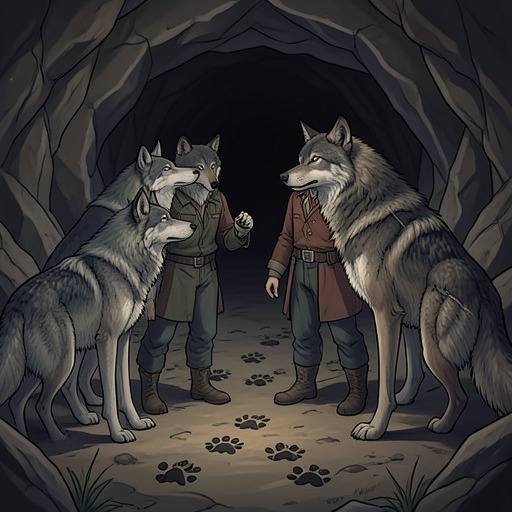
Alpha Leadership in the Werewolf Pack
How to Flirt with A Naked WerewolfAlpha Leadership in the Werewolf Pack is both a werewolf status associated with transformation and strength and a position of authority over the pack. Its course—from Cooper’s expected succession, through Eli’s command and the crisis of his leadership, to Maggie’s election by secret ballot—shows that inherited expectations do not settle who can lead or what makes a leader worthy of the role.
Inheritance, Transformation, and Expectation
Evie describes the pack as organized by generations: every generation produces a pack, and every pack has a leader. The arrangement is presented as a natural order, but the narrative links the expectation of leadership to the capacity to become a wolf. Evie’s own family branch is a dead line, while Cooper’s line has produced wolves across its generations. Cooper was among the first children in his generation to transform, and his speed and strength made him the expected alpha almost immediately. His designation thus rests on observable physical distinction as well as his place in a transforming family line.
That expected role is bound to territory. Cooper leaves the packlands in Crescent Valley for Grundy, roughly a hundred miles away, although Evie says that a werewolf’s instincts urge it to protect, hunt, and live in a particular area. For Cooper, distance from home is not merely a change of residence but a sustained struggle against that pull. His departure also means leaving the leadership he was expected to assume. Alpha status therefore carries obligations and pressures that reach beyond the individual: the pack’s land, its inherited order, and the life its members are accustomed to share all shape what leadership asks of him.
The system is not entirely insulated from change in the bloodlines that sustain it. Cooper explains that marriages outside the pack have increased the number of dead lines, and his grandfather regards that development as preferable to excessive inbreeding. The account does not say that every dead line eliminates a possible leader, but it does place the pack’s leadership expectations within a kinship structure whose transforming capacity is changing over time.
Cooper’s Crisis and the Limits of Strength
About a year after Cooper became alpha, a rival pack from outside Vancouver arrived in Crescent Valley. Its members had exhausted their own hunting grounds and wanted access to the valley. Their alpha, Jonas, had gathered information about the packlands, the village, and the number of able fighters before confronting Cooper. He threatened Maggie’s life to force Cooper to surrender control of the territory.
Surrounded by his family, Cooper could think only to offer the newcomers a place in the valley. Jonas refused. Cooper later recalled freezing while the people around him looked to him for a solution. The failure was especially painful because Maggie, held by Jonas, trusted her brother to protect her even as Cooper was terrified and unable to act. Maggie escaped through her own intervention: she bit Jonas’s arm, kicked him, and called him a name. The episode makes the gap between being identified as the strongest candidate and successfully exercising leadership stark. Cooper’s physical distinction had prepared others to expect decisive protection, but it could not supply a decision when the crisis arrived. His memory of Maggie realizing he did not know what to do remained a source of nightmares.
Eli later frames Cooper’s style as weakness, claiming that the pack needed strength rather than fairness and equality. That judgment is Eli’s own account of the rivalry, not a neutral description of Cooper’s rule: Eli resents being second to Cooper and admits that he wanted leadership for himself. His ambition also connects the leadership struggle to the earlier incursion. Eli says he had been sending information to the rival pack for months and expected their attack to help him advance, though he describes their operation as a fiasco. The pack’s authority is therefore vulnerable not only to an outside challenge but also to internal members willing to endanger the community to displace its leader.
Command, Restraint, and Pack Rules
Eli asserts command over Maggie during a confrontation, ordering her to step down and declaring that he leads the pack. He directs her away from Mo, and, after resisting and taking a swipe at Mo, Maggie finally leaves. The scene depicts leadership operating through spoken command and physical control, while Maggie’s resistance shows that an order does not make its authority uncontested. Eli’s intervention ends the immediate confrontation, but it does not establish that his approach has earned the pack’s durable allegiance.
A further constraint limits how an alpha can be challenged. Eli says that he cannot personally harm Cooper because of a biological imperative: unless Cooper attacks him first, Eli is unable to touch him. Eli contrasts that prohibition with Cooper’s inability to prevent other wolves, including Samson and Maggie, from going after him. The rule creates an asymmetry between the alpha and a would-be rival: Eli cannot simply attack Cooper himself, but he can make matters difficult for him by other means. In Eli’s account, that restriction helps explain why he pursues indirect pressure rather than a direct assault; his campaign relies on threats to what Cooper cares about and on actions that do not require Eli to strike the alpha personally.
The authority attached to alpha status can also be expressed protectively in private life. After Cooper returns to Grundy, he keeps careful watch over Mo and their expected child, takes heavy objects from her, insists that she rest, and growls at people who speak to her harshly. These acts are directed toward his partner rather than presented as exercises of formal pack government. They nevertheless contrast with Eli’s account of strength as dominance: Cooper’s protection appears as practical care, even as Mo and Evie push back when he tries to reduce Mo’s working hours.
From Expected Succession to Election
After Eli’s loss, Cooper still has no interest in taking up the alpha role again, but he visits the packlands more often. The pack responds to the leadership question by adopting a more democratic selection process: after an all-night meeting, its members decide that the alpha will be chosen by secret ballot. This procedure is a consequential change from the earlier emphasis on the leader anticipated through a generation’s strongest transformers. The narrative presents it as the pack’s decision, without claiming that the old biological expectations have disappeared.
Samson is nominated, but the wolves do not believe he would take the position seriously. Maggie wins by a landslide. Although she lacks the genetic conditioning associated with an alpha, she exercises authority effectively. The pack fears her, but fear is not her only qualification: her judgment is described as fair, swift, and generally in the people’s best interests. She is also finally happy, and on a later visit she offers Mo a small, tentative sign of warmth. Her leadership thus combines forceful personal authority with demonstrated judgment, while her election gives the pack a means of choosing a leader rather than simply waiting for a predicted successor.
Significance
The leadership system brings together lineage, bodily capacity, territory, obedience, and political choice without making them equivalent. Cooper is expected to lead because he transforms and excels physically, yet his departure and paralysis under threat expose the difference between designation and action. Eli’s command shows how alpha authority can be asserted and how restrictions on direct violence can channel a rival toward manipulation. Maggie’s election, despite her lack of the usual genetic conditioning, establishes that pack members can authorize leadership through a collective decision and judge it by the quality of its use.
The change does not erase the pack’s inherited customs or make leadership free of coercion: Maggie’s authority still includes the fear she inspires, and the story does not specify that the secret-ballot process will govern every future succession. It does, however, move the office beyond a purely naturalized claim. The pack’s final arrangement makes room for strength and inherited expectations while also recognizing conduct, judgment, and communal choice as grounds for rule.